
The 1900-O/CC Morgan Dollar — The Last Carson City Silver Dollar
OMMThe Last Carson City Morgan Dollar
The Carson City Mint closed in 1893. Seven years later, its ghost appeared on a Morgan Dollar.
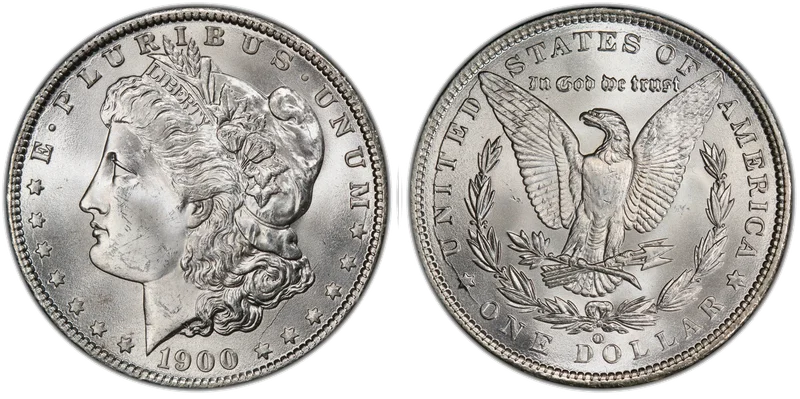
The Carson City Mint only struck silver Morgan Dollars for 13 years, from 1878 to 1893. Due to this limited run, Morgan Dollars bearing the "CC" mint mark are among the most sought-after coins in American numismatics. But devoted Carson City collectors also seek out a rare variety produced in 1900 — seven years after the last regular-issue CC Morgan rolled off the presses. It is sometimes called "The Last Carson City Morgan Dollar."
Why Carson City?
The Carson City Mint was established in 1870 to process the enormous silver output of the Comstock Lode in nearby Virginia City, Nevada. Rather than shipping raw silver across the country to Philadelphia, the government built a mint closer to the source. For over two decades, the Carson City Mint struck silver and gold coins that circulated throughout the American West.
But the Comstock Lode's output declined through the 1880s, and by 1893 the Carson City Mint struck its final coins. The facility was officially decommissioned as a U.S. Mint in 1899. With that closure ended any hope of ever seeing "CC" on a Morgan Dollar again.
Or so everyone thought.
The Mystery
In 1900, the New Orleans Mint struck Morgan Dollars bearing the "O" mint mark — business as usual. But on some of these coins, careful examination reveals something unexpected beneath the "O": the faint but unmistakable outline of "CC" showing through.
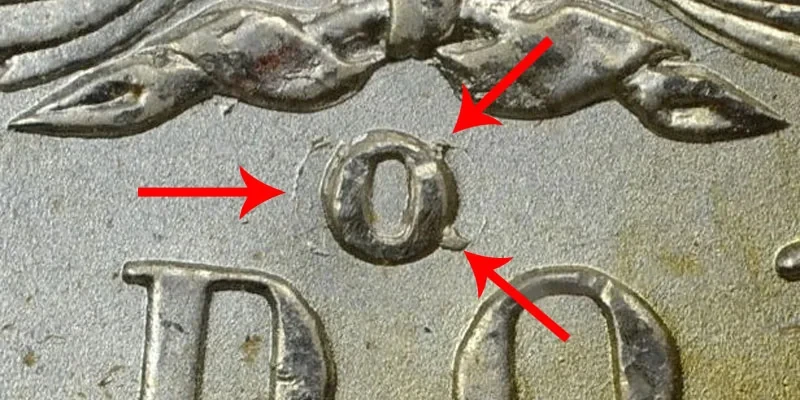
The "O" mint mark with the ghost of "CC" visible beneath. Red arrows indicate where the original Carson City mint mark shows through the New Orleans overpunch.
How did a Carson City mint mark end up on a coin struck seven years after that mint closed?
Theory 1: Repurposed Dies
All Morgan Dollar dies were manufactured at the Philadelphia Mint before being shipped to branch mints. When the Carson City Mint closed in 1893, Philadelphia may have had extra reverse dies already punched with "CC" mint marks — dies that were prepared in advance but never shipped.
Rather than destroying these unused dies, a practical-minded mint worker may have repurposed them by stamping the New Orleans "O" mint mark directly over the existing "CC." This theory is generally considered the more likely explanation, since multiple dies were affected — not just one.
Theory 2: A Mint Worker's Mistake
At the time, mint marks were hand-punched onto individual dies after they were manufactured. A "CC" punch may still have existed at the Philadelphia Mint alongside the other mint mark punches. An absent-minded worker could have grabbed the wrong punch, stamped "CC" onto dies intended for New Orleans, and then corrected the error by overpunching with the proper "O."
How Many Exist?
As noted by Leroy Van Allen and A. George Mallis in their Comprehensive Catalog and Encyclopedia of Morgan and Peace Dollars, at least six die marriages contain the O/CC over mint mark variety. With over 12.5 million 1900-O Morgan Dollars struck, researchers estimate that perhaps 10% of the original mintage — roughly 1.2 million coins — may have been struck from O/CC dies.
Despite that potentially large original production, identifying the variety requires magnification and careful examination. Between PCGS and NGC, approximately 12,000 examples have been certified with this attribution to date.
What to Look For
The diagnostic feature is visible on the reverse, directly below the eagle's tail feathers where the mint mark sits. Under 5x–10x magnification, look for:
- The tops of the "CC" extending above and to the sides of the "O"
- A slightly irregular or "busy" appearance to the mint mark area compared to a normal 1900-O
- Remnants of the serif details from the original "C" letters visible within or around the "O"
The over mint mark is present on all six known die marriages, though the clarity of the underlying CC varies from die to die. Some show bold, easily visible CC remnants; others require careful examination under good lighting.
Collector Value
The 1900-O/CC trades at a meaningful premium over a regular 1900-O Morgan Dollar:
| Grade | Regular 1900-O | 1900-O/CC |
|---|---|---|
| VF-20 | ~$40 | ~$120 |
| AU-50 | ~$55 | ~$210 |
| MS-63 | ~$100 | ~$750 |
| MS-65 | ~$425 | ~$1,750 |
| MS-67+ | Rare | $52,875 (auction record) |
The variety is accessible enough to find in dealer inventories but scarce enough to command real premiums, especially in higher grades. For Carson City collectors who have completed their 1878–1893 CC date set, the 1900-O/CC offers one more piece of the story.
The Last Carson City Morgan Dollar
While 1893 will always be the year the Carson City Mint struck its final silver dollar, the 1900-O/CC carries a piece of Carson City with it — a ghost mint mark from a mint that had already closed, preserved in steel and silver. Whether the result of frugality or a simple mistake, it remains one of the most fascinating over mint mark varieties in all of numismatics.
Over mint marks like the 1900-O/CC occur when two different mint mark letters appear on the same die — one punched over the other. To learn more about how these varieties are created and identified, visit our Over Mint Mark (OMM) learn page. You can also browse 1900-O Morgan Dollar listings in the NumisDex catalog.
0 Replies
Related Threads
- Rosa Parks Commemorative Coins: HR 916 Would Honor a Civil Rights Icon0 replies · 2mo ago
- Olympic Coins for LA 2028 and Salt Lake City 2034: S. 2265 Explained0 replies · 2mo ago
- The End of the Penny: What HR 4459 (MINT Act) Means for Collectors0 replies · 2mo ago
- The $2.50 Coin Is Coming Back: What Collectors Need to Know About HR 56160 replies · 2mo ago
- U.S. Mint Releasing 250,000 Special "July 4th" Privy Mark Declaration of Independence Quarters0 replies · 2mo ago