
The 16th Known 1804 Silver Dollar: How the James A. Stack Discovery Rewrote Numismatic History
A Previously Unknown 1804 Dollar Surfaces After Decades in Hiding
On December 9, 2025, Stack's Bowers Galleries auctioned a coin that the numismatic world didn't know existed: the 16th known specimen of the 1804 Draped Bust Silver Dollar. Consigned from the estate of James A. Stack, Sr. — a New York textile executive with no relation to the auction house's founding family — the coin sold for $6,000,000, nearly tripling the previous record for a Class III 1804 dollar.
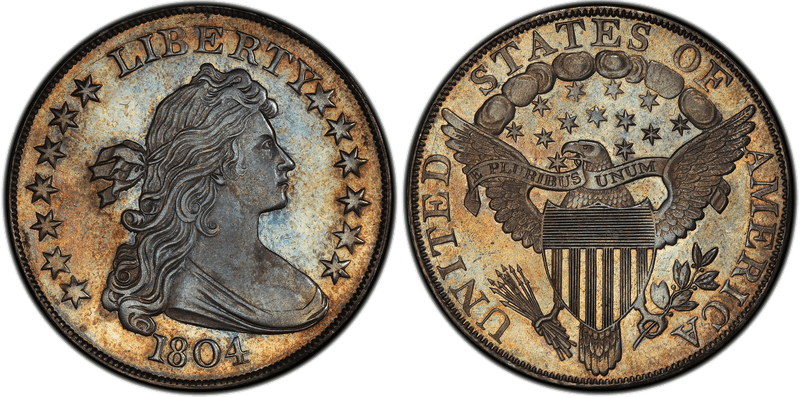
The 1804 Draped Bust Dollar — the "King of American Coins." Browse all known varieties in the NumisDex catalog.
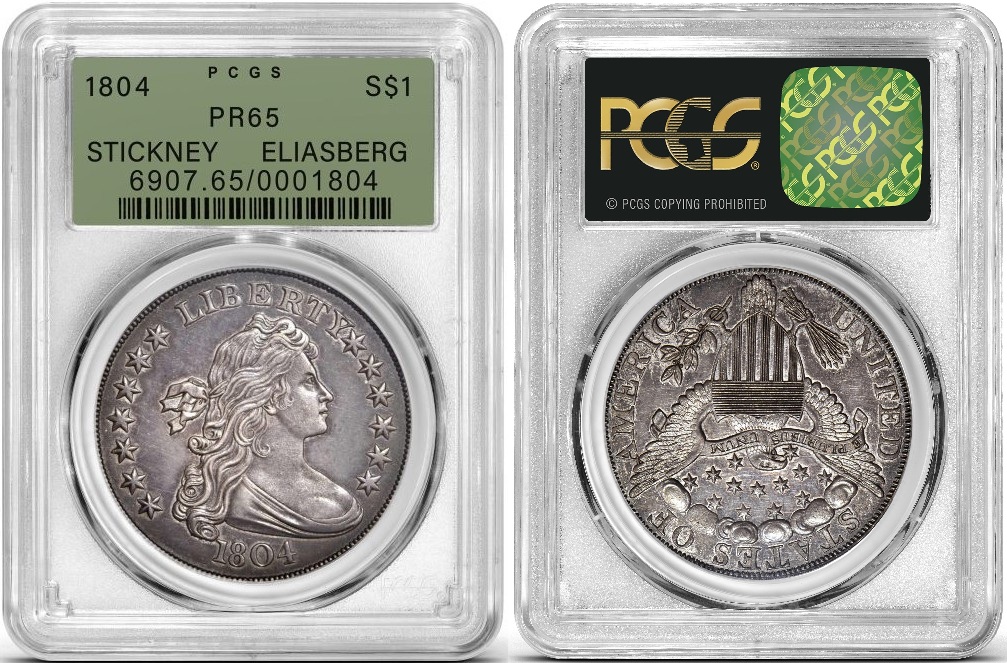
An 1804 Dollar in a certified holder — third-party grading provides authentication and market confidence for coins at this level.
Why the 1804 Dollar Is the "King of American Coins"
Despite bearing the date 1804, no silver dollars were actually struck that year. The U.S. Mint suspended dollar production in 1803 and didn't resume it until 1836. So where did 1804 dollars come from?
In the early 1830s, President Andrew Jackson's administration ordered the Mint to produce special proof coin sets as diplomatic gifts for Asian rulers to facilitate trade agreements. The Mint needed a dollar for these sets, and since the last dollars produced bore the date 1803, officials decided to create new dies dated 1804 — the year Mint records showed dollar production was last authorized.
Edmund Roberts delivered these sets to the Sultan of Muscat on October 1, 1835, and to King Rama III of Siam on April 6, 1836. The coins struck for these diplomatic sets are now classified as Class I specimens — eight are known to survive.
The Three Classes of 1804 Dollars
- Class I (8 known) — Original diplomatic presentation strikes, produced circa 1834-1835. These include the Sultan of Muscat specimen (PCGS PR-68, sold for $7.68 million in August 2021) and the King of Siam specimen.
- Class II (1 known) — A unique specimen struck surreptitiously at the Mint around 1858 with a plain, unlettered edge. It resides in the Smithsonian Institution.
- Class III (now 7 known) — Class II-style coins that later had edge lettering applied. The Stack specimen brought the count from 6 to 7.
The Stack Discovery
James A. Stack, Sr. was a collector whose holdings had been completely unknown to the numismatic community. No dealer, auction house, or researcher knew this coin existed until it was consigned. The census of known 1804 dollars had been stable since 1962, when the King of Siam specimen was rediscovered — making the Stack coin the first new discovery in over 60 years.
The coin was graded PCGS Proof-65 with a CAC sticker — making it the only CAC-approved 1804 dollar of any class. The total Stack Collection auction (Session 1, 54 lots) realized $14.8 million, with an average lot price exceeding $200,000.
What This Means for Collectors
The 1804 dollar is a reminder that major numismatic discoveries still happen. While an 1804 dollar is far beyond most collectors' budgets, the Stack discovery illustrates important principles:
- Significant coins can remain hidden in private collections for decades
- Census counts for rare coins are estimates — the true population is always uncertain
- Provenance and pedigree matter enormously for coins at this level
- Third-party certification (PCGS/NGC) with CAC approval provides the strongest market confidence
For a deep dive into every known 1804 dollar variety, explore the 1804 Dollar listings in the NumisDex catalog.
0 Replies
Related Threads
- Rosa Parks Commemorative Coins: HR 916 Would Honor a Civil Rights Icon0 replies · 2mo ago
- Olympic Coins for LA 2028 and Salt Lake City 2034: S. 2265 Explained0 replies · 2mo ago
- The End of the Penny: What HR 4459 (MINT Act) Means for Collectors0 replies · 2mo ago
- The $2.50 Coin Is Coming Back: What Collectors Need to Know About HR 56160 replies · 2mo ago
- U.S. Mint Releasing 250,000 Special "July 4th" Privy Mark Declaration of Independence Quarters0 replies · 2mo ago