
1966 Silver Quarter Found in 2025: What a Transitional Error Is and Why This One Matters
A Quarter That Shouldn't Exist: Silver in a Clad World
In 2025, a 1966 Washington quarter struck on a 90% silver planchet surfaced at auction, reaching bidding of $24,400 at Stack's Bowers. The coin belonged to a collector's father who had recognized decades earlier that the quarter appeared to be silver — and shouldn't have been. After his passing, the coin sat in a drawer before finally being submitted for authentication.
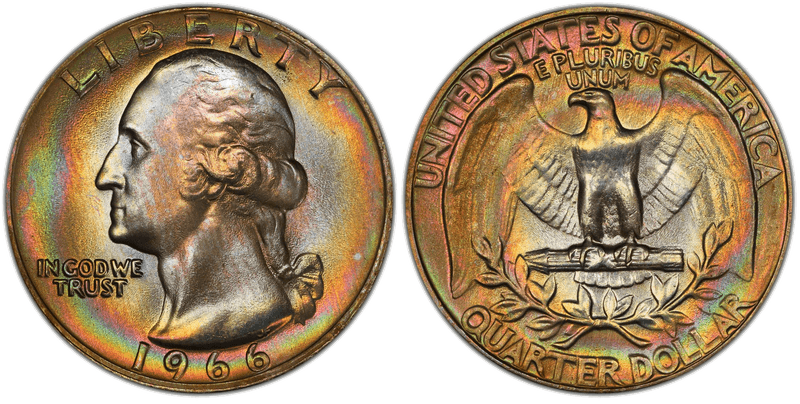
A standard 1966 Washington Quarter on clad planchet. Browse the 1966 Washington Quarter in the NumisDex catalog.
What Is a Transitional Error?
A transitional error occurs when a coin is struck on the wrong planchet due to a composition change between years. In 1965, the U.S. Mint switched from 90% silver to copper-nickel clad for dimes and quarters as part of the Coinage Act of 1965. Any leftover silver planchet that accidentally made it into a press after the switch would produce a transitional error — a coin with a current-year date struck on the previous year's metal composition.
The most famous transitional errors are:
- 1965 silver dime — Roosevelt dime struck on a leftover 90% silver planchet
- 1965, 1966, 1967 silver quarters — Washington quarters on silver planchets
- 1943 copper cent — Lincoln cent struck on a leftover bronze planchet during the WWII zinc-coated steel cent year
- 1944 steel cent — Lincoln cent struck on a leftover steel planchet after the Mint returned to copper
How to Identify a Silver Quarter vs. Clad
Two tests separate a silver quarter from a clad one:
1. Weight: A silver quarter weighs approximately 6.25 grams. A clad quarter weighs approximately 5.67 grams. A precision scale accurate to 0.01 grams is essential — kitchen scales are not precise enough for this purpose.
2. Edge examination: A clad quarter shows the distinctive copper "sandwich" at the edge — a thin copper core visible between the outer nickel-copper layers. A silver quarter's edge appears uniformly silver throughout, with no copper line.
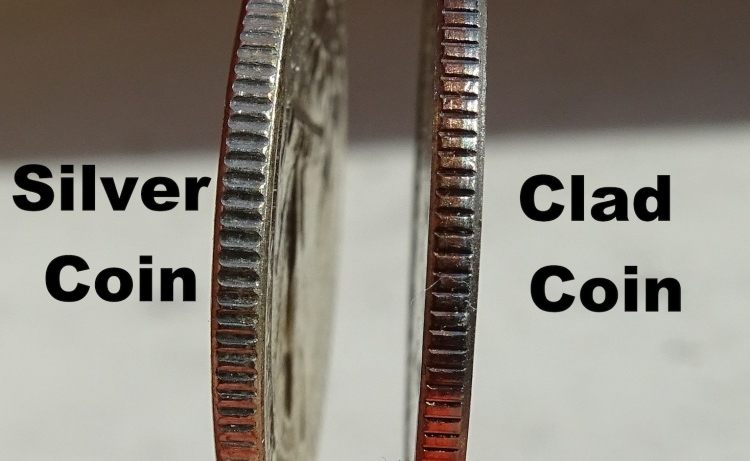
Edge comparison: silver shows uniform metal throughout, while clad reveals the copper core between outer layers.
Authentication Challenges
Claiming a post-1964 silver quarter is serious business. The authentication process for transitional errors is rigorous because:
- Canadian silver quarters (which circulated alongside U.S. quarters until 1968) weigh similarly and can be confused with U.S. silver transitional errors
- Silver-plated clad quarters exist as novelty items and can fool visual inspection
- XRF (X-ray fluorescence) testing or specific gravity testing may be needed beyond simple weighing
- The coin that surfaced in 2025 had a complicated authentication history — ANACS initially returned it as "unable to verify" before it was eventually authenticated through other channels
Professional certification by PCGS or NGC is essential for any transitional error claim. Without it, the coin is essentially unsellable at premium prices.
Why These Are So Rare
When the Mint changed compositions, entire production lines were converted. Leftover planchets had to physically remain in a hopper or bin to be accidentally fed into a press. The Mint's quality control procedures made this unlikely but not impossible — which is why these coins command five-figure prices when authenticated.
If you suspect you have a transitional error, start with weight. If it's the right weight for the wrong metal, seek professional authentication immediately.
0 Replies
Related Threads
- Rosa Parks Commemorative Coins: HR 916 Would Honor a Civil Rights Icon0 replies · 2mo ago
- Olympic Coins for LA 2028 and Salt Lake City 2034: S. 2265 Explained0 replies · 2mo ago
- The End of the Penny: What HR 4459 (MINT Act) Means for Collectors0 replies · 2mo ago
- The $2.50 Coin Is Coming Back: What Collectors Need to Know About HR 56160 replies · 2mo ago
- U.S. Mint Releasing 250,000 Special "July 4th" Privy Mark Declaration of Independence Quarters0 replies · 2mo ago