
(No Date) Copper Civil War Store Card F-430A-1a, Barry & M''Dannel TN
Strike Type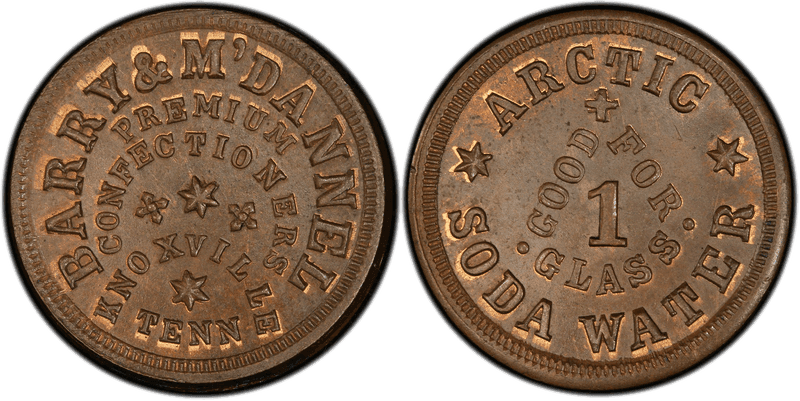
Coin Details
Description
Barry & M'Dannel, based in Knoxville, Tennessee, produced this token as a cent substitute during the wartime coin shortage. Tennessee was divided during the Civil War. Nashville fell to Union forces in 1862, and merchants in Union-controlled areas issued tokens as emergency small change. Barry & M'Dannel issued 5 die varieties, more than most Civil War merchants. The copper composition of this variety (Fuld 430A-1a) is common for this merchant. Most Civil War store cards carry no date; this token was struck during the 1862-1864 coin shortage era. Many Civil War tokens share common reverse dies, as die sinkers paired merchant-specific obverses with stock patriotic or advertising reverses. Congress banned private token issuance in April 1864, but before that, tokens like this one circulated freely as cent substitutes in Northern commerce. After Congress banned private coinage in 1864, surviving tokens became instant collectibles, with serious collecting beginning within a decade of the war's end.
Rarity Notes
Copper strikings are generally the most common metal variant for Civil War store cards, as copper was the standard planchet material mimicking the federal cent. With 5 cataloged varieties, Barry & M'Dannel was a minor token issuer.
Cross References
Fuld 430A-1a
External References
Error Varieties
No listings found
This category doesn't have any child listings yet.