
1906 Proof Double Eagle Pattern - J-1773
Strike Type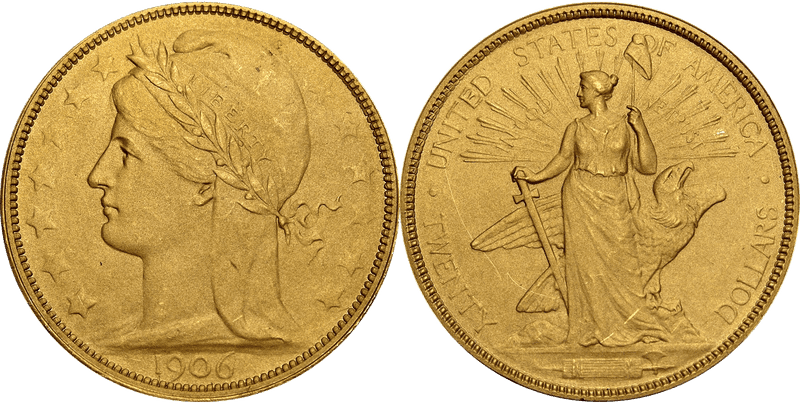
Coin Details
Auction Record
$5,520 Proof 61 02-18-2002 Goldberg Auctioneers
Description
Judd-1773 is a proof double eagle pattern struck in gold at the Philadelphia Mint in 1906, the final year before President Theodore Roosevelt's dramatic intervention transformed American gold coinage. This pattern features Charles Barber's existing Liberty Head design on the obverse and heraldic eagle on the reverse, representing the culmination of the established double eagle design tradition that had served since James B. Longacre's original 1849 concept. Struck under Barber's direction as Chief Engraver, J-1773 documents the state of double eagle design thinking immediately before Roosevelt commissioned Augustus Saint-Gaudens to reimagine the denomination entirely. Roosevelt, who famously complained that American coins were "artistically of atrocious hideousness," had already begun private correspondence with Saint-Gaudens by late 1905, making this 1906 pattern one of the last expressions of the pre-Roosevelt design philosophy. The coin was struck in the standard gold composition on a proof planchet with mirror fields and frosted devices. Its significance lies primarily in its position as a historical bookend — the final Barber-era double eagle pattern before the most celebrated redesign in American numismatic history.
Rarity Notes
R-7 to R-8 (Extremely Rare). Gold double eagle patterns from this period survive in very small numbers, fewer than 10 specimens.
Cross References
Judd J-1773, Pollock P-1963
External References
Error Varieties
No listings found
This category doesn't have any child listings yet.
Related Strike Types in This Denomination
Collector Essentials
Tools and references for building and protecting your coin collection.
10x-20x Jeweler's Loupe
A must-have for examining coin details, mint marks, and surface quality
Red Book — Guide to U.S. Coins
The essential annual reference for U.S. coin values, history, and mintages
Coin Albums & Storage
Archival-quality albums and holders to protect and display your collection
USB Digital Microscope
Capture detailed images for documentation and community submissions
As an Amazon Associate, NumisDex earns from qualifying purchases.