
1864 HT-267, Feuchtwanger's Eagle Three Cent
Strike Type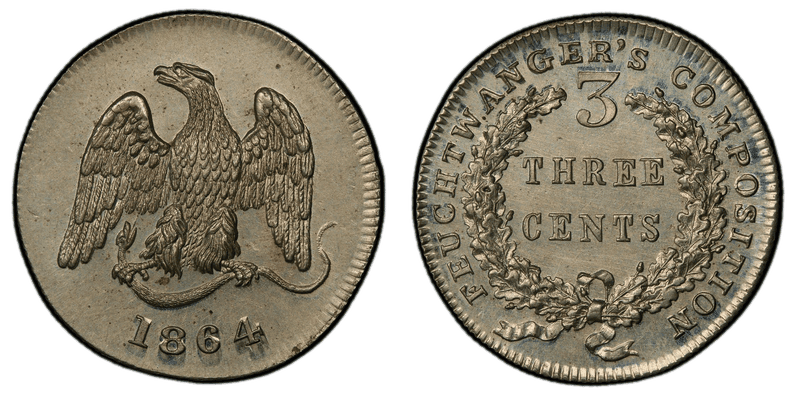
Coin Details
Auction Record
$11,750 MS64 02-16-2017 Heritage Auctions
Description
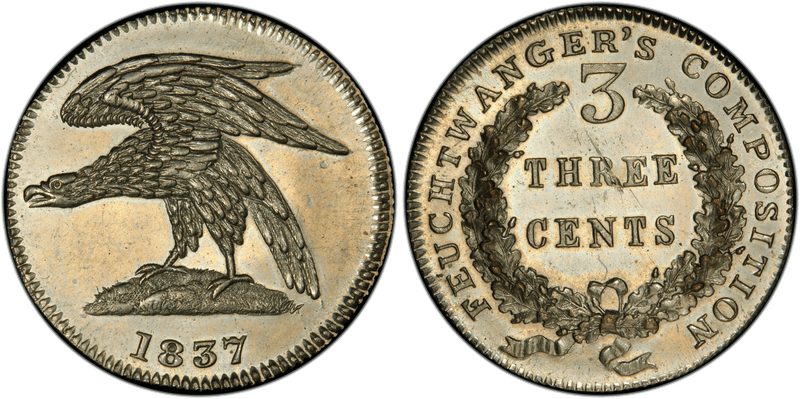
The 1864 Feuchtwanger Eagle Three Cent is a rare Civil War-era reissue that bridges the two great private coinage periods in American numismatic history. Twenty-seven years after his original 1837 petition to Congress, Dr. Lewis Feuchtwanger struck a new three-cent token using a fresh 1864-dated obverse die paired with the same reverse die from his 1837 Low-119 presentation strikes (HT-265A/WB-102). This remarkable die linkage — the oak wreath reverse with denomination expressed twice — creates a direct physical connection between the Hard Times token era and the Civil War token era. By 1862, the second year of the Civil War, virtually all government-issued coinage had disappeared from Northern circulation through hoarding, speculation, and export. The resulting small-change vacuum was filled by approximately ten thousand varieties of privately-issued Civil War cent tokens, postage stamps used as currency, and Fractional Currency notes. Congress acted to ban private coinage in two stages: the Act of April 22, 1864 prohibited private one-cent and two-cent pieces, while the Act of June 8, 1864 banned all private coinage. Feuchtwanger's three-cent denomination occupied a brief legal gray area between these two acts, though these tokens were struck primarily as collector pieces or as a final symbolic renewal of his metallurgical proposal rather than as practical circulating currency. The obverse depicts an open displayed eagle with the date 1864 prominently below, while the reverse carries the distinctive oak wreath and dual THREE CENTS denomination from the original 1837 Low-119 die. Feuchtwanger's preservation of this reverse die for twenty-seven years confirms his continued commitment to his metallurgical vision: he viewed the Civil War monetary crisis as a parallel to the Panic of 1837 — a second vindication of his argument that the United States needed a durable, inexpensive alloy for small-denomination coinage. Dr. Feuchtwanger died in New York City on June 25, 1876, twelve years after this final numismatic statement.
Rarity Notes
Rarity R-6 (rare). Far scarcer than any 1837 Feuchtwanger issue except the Low-119 special strikes (R-7). An estimated 13 to 30 surviving examples across all grades based on the R-6 designation. Choice Mint State examples are genuinely rare. An MS-64 PCGS CAC example sold at Heritage Auctions in January 2012 (Lot 3221). EF to AU examples: $800-$1,500; MS-63: $2,000-$4,000; MS-64 and above: $5,000+.
Cross References
Low-179A; PCGS #20003. Reverse die linked to the 1837 Low-119 / HT-265A / WB-102 (oak wreath, denomination expressed twice). Part of the PCGS Feuchtwanger Tokens (1837-1864) five-piece registry set. Struck during the Civil War token era but classified with the Feuchtwanger series rather than with general Civil War tokens.
External References
Error Varieties
No listings found
This category doesn't have any child listings yet.
Related Strike Types in This Denomination
Collector Essentials
Tools and references for building and protecting your coin collection.
10x-20x Jeweler's Loupe
A must-have for examining coin details, mint marks, and surface quality
Red Book — Guide to U.S. Coins
The essential annual reference for U.S. coin values, history, and mintages
Coin Albums & Storage
Archival-quality albums and holders to protect and display your collection
USB Digital Microscope
Capture detailed images for documentation and community submissions
As an Amazon Associate, NumisDex earns from qualifying purchases.