
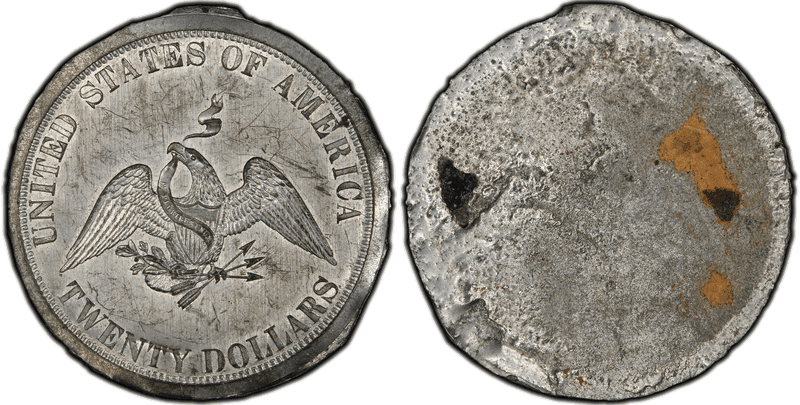
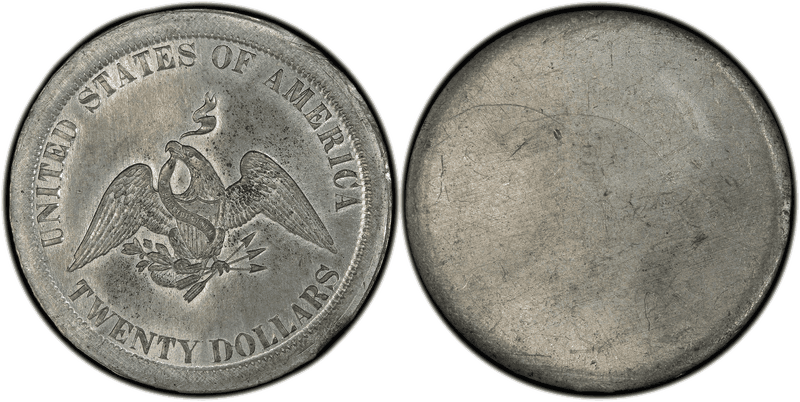
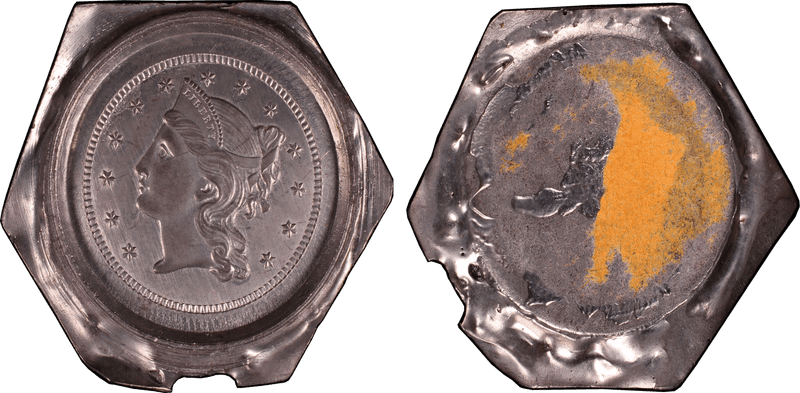
1857 Double Eagle Die Trial - J-A1857-8, Reverse
Strike Type
Coin Details
Auction Record
$12,925 MS63 01-06-2016 Heritage Auctions
Description
This reverse die trial of an 1857 Liberty Head double eagle provides an isolated view of the denomination's eagle design without the influence of the obverse die. The reverse features James Barton Longacre's spread eagle with a shield on its breast, clutching an olive branch and a bundle of arrows, with "UNITED STATES OF AMERICA" arched above and "TWENTY D." below, surrounded by a border of rays. Reverse-only die trials were produced by pressing a single die into a blank planchet, which allowed Mint technicians to evaluate that specific die's condition in isolation. This diagnostic technique was particularly valuable for detecting subtle die deterioration — hairline cracks, fill in the lettering, or weakening of design details that might be difficult to distinguish on a fully struck two-sided coin. The 1857 date places this during the height of double eagle production at the Philadelphia Mint, where 439,375 pieces were struck that year. The double eagle was the workhorse of international gold commerce during this period, with American $20 gold pieces circulating worldwide as a trusted store of value. Maintaining the quality of these high-denomination dies was critical to the Mint's reputation, and reverse die trials like this specimen were one tool in the quality control arsenal. The Judd-A1857-8 designation distinguishes this from other 1857 double eagle die trial varieties, including J-A1857-7 and J-A1857-9, indicating multiple test impressions were taken from different die states or configurations.
Rarity Notes
Very rare. Reverse die trials of Liberty Head double eagles are seldom encountered, with individual Judd appendix varieties typically known in one to three specimens.
Cross References
Judd-A1857-8
External References
Error Varieties
No listings found
This category doesn't have any child listings yet.
Other Strike Types in This Series

Collector Essentials
Tools and references for building and protecting your coin collection.
10x-20x Jeweler's Loupe
A must-have for examining coin details, mint marks, and surface quality
Red Book — Guide to U.S. Coins
The essential annual reference for U.S. coin values, history, and mintages
Coin Albums & Storage
Archival-quality albums and holders to protect and display your collection
USB Digital Microscope
Capture detailed images for documentation and community submissions
As an Amazon Associate, NumisDex earns from qualifying purchases.