
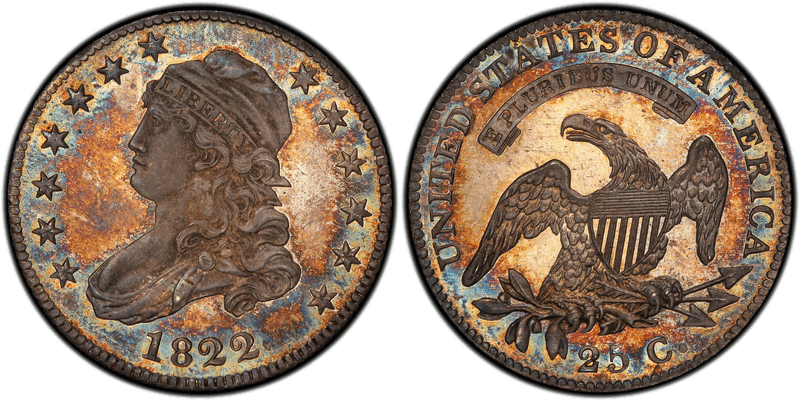
1822 Proof Capped Bust Quarter - 25/50C
Strike Type
Coin Details
Value Estimates
Values as of May 2026 — estimates reflect typical grades (G-4 through MS-63). Coins in lower or exceptional grades may fall outside this range.
Description
The 1822 Proof Capped Bust Quarter - 25/50C is part of the Capped Bust Quarters 1815-1838 series. This is a blundered denomination variety: the reverse die was initially engraved with "50 C." for a half dollar, then corrected to read "25 C." for a quarter. The underlying "50" remains visible beneath the "25," creating one of the most dramatic die errors in early U.S. coinage. Research by Steve Tompkins suggests the die originated around 1818. The same blundered reverse die was pulled from storage and reused for the 1828 B-3 quarter six years later, demonstrating how the early Mint conserved valuable die steel. PCGS estimates approximately 42 survivors across all grades, making this two to three times scarcer than the normal 1822 reverse. With a mintage of only 6, this is an extremely rare issue. The obverse features Liberty facing left wearing a mob cap or turban, while the reverse displays a heraldic eagle with shield on breast, olive branch and arrows in talons, with a banner reading E PLURIBUS UNUM. Designed by John Reich. Struck in 89.2% silver, 10.8% copper, weighing 6.74 grams, 27.5 mm in diameter, with a reeded edge. Cataloged as PCGS #5367. The Capped Bust Quarter was first struck in 1815 — there is no 1808-1814 quarter production — making the 1815 a historically important first-year issue. The 1823/2 overdate is a classic rarity. The 1827 original (restrike controversial) and certain proof-only dates attract specialized collectors.
External References
Error Varieties
No listings found
This category doesn't have any child listings yet.
Other Strike Types in This Series


Collector Essentials
Tools and references for building and protecting your coin collection.
10x-20x Jeweler's Loupe
A must-have for examining coin details, mint marks, and surface quality
Red Book — Guide to U.S. Coins
The essential annual reference for U.S. coin values, history, and mintages
Coin Albums & Storage
Archival-quality albums and holders to protect and display your collection
USB Digital Microscope
Capture detailed images for documentation and community submissions
As an Amazon Associate, NumisDex earns from qualifying purchases.