
The Penny Used to Be the Size of a Half Dollar: A Complete Guide to Large Cents (1793-1857)
Pick up a modern penny. Now imagine one the size of a half dollar. That's what a cent looked like for the first 64 years of the United States Mint.
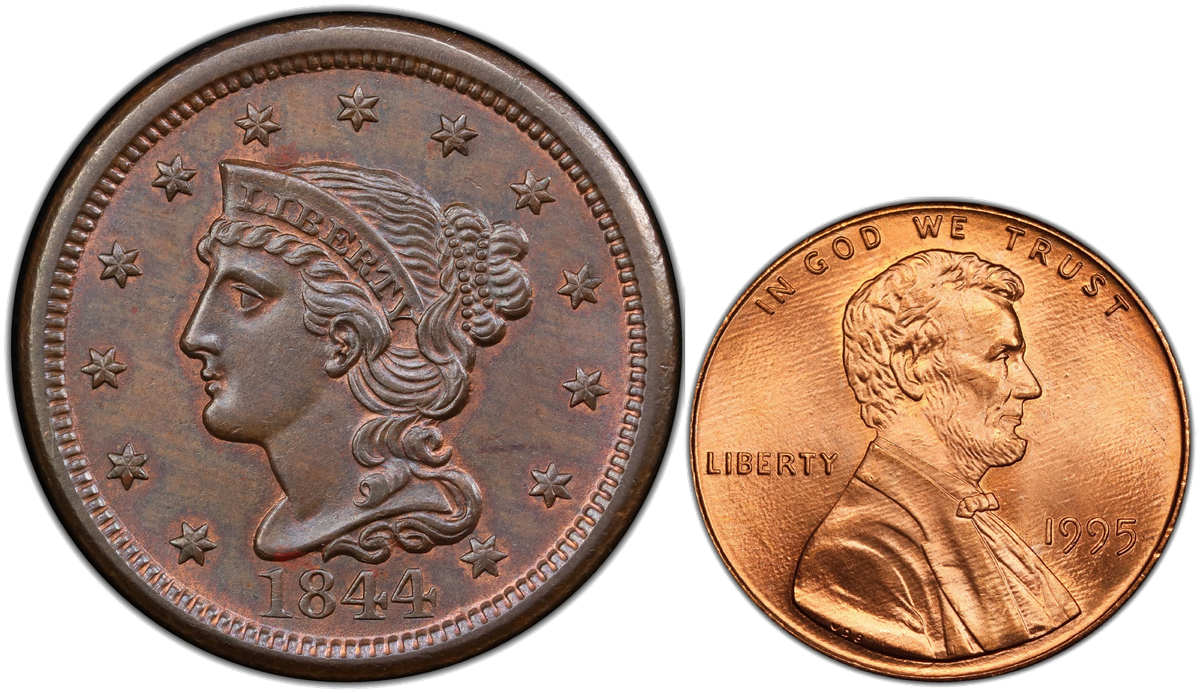
Size comparison — a large cent (left) dwarfs the modern Lincoln cent (right), showing why the Mint eventually downsized the denomination
Large cents were among the very first coins struck by the U.S. Mint, and they're one of the most historically rich series in American numismatics. From 1793 to 1857, the Mint produced cents that were roughly 28-29mm in diameter -- nearly the size of today's Kennedy half dollar -- and made of pure copper. They weighed about 10.9 grams, more than four times the weight of a modern cent.
Seven Designs, Seven Chapters of American History
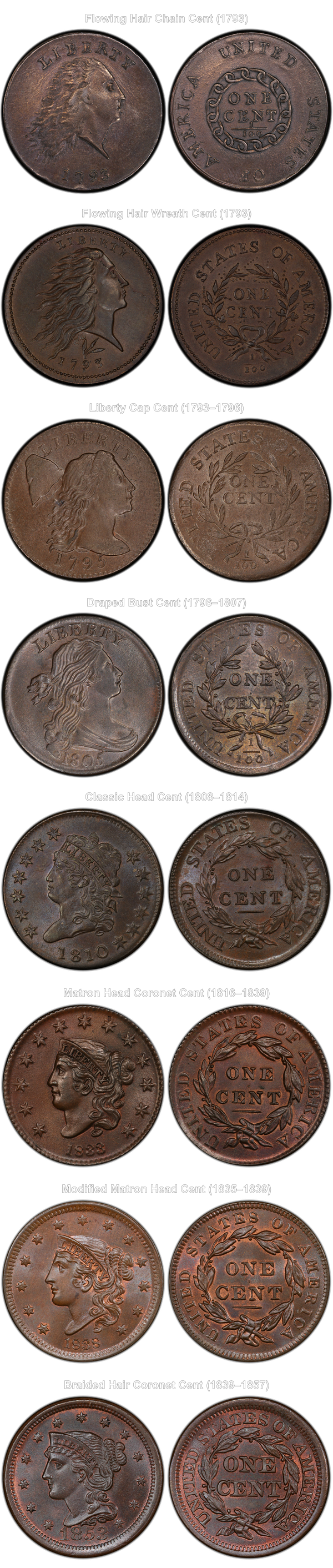
The complete evolution of large cent designs — from the 1793 Flowing Hair Chain Cent through the final 1857 Braided Hair Coronet
The large cent went through more design changes than almost any other U.S. coin denomination. Each design reflects the Mint's evolving capabilities and the young nation's changing identity.
| Design | Years | Designer | Key Fact |
|---|---|---|---|
| Flowing Hair Chain | 1793 | Henry Voigt | The very first U.S. cent. The chain reverse was controversial -- critics said it symbolized tyranny, not unity. Only ~36,000 struck before the design was pulled. |
| Flowing Hair Wreath | 1793 | Adam Eckfeldt | Replaced the chain design in the same year. The wreath was considered a more appropriate symbol for a new republic. |
| Liberty Cap | 1793-1796 | Joseph Wright / John Smith Gardner | The Phrygian cap on a pole -- a symbol of freed slaves in ancient Rome. Three different engravers worked on this design. |
| Draped Bust | 1796-1807 | Robert Scot (after Gilbert Stuart) | One of the most iconic early American designs. The 1799 is a major key date with a mintage under 43,000. |
| Classic Head | 1808-1814 | John Reich | A short-lived but elegant design. The last year, 1814, was struck in limited numbers due to wartime copper shortages. |
| Coronet / Matron Head | 1816-1839 | Robert Scot / Christian Gobrecht | The longest-running large cent design. Underwent several subtle modifications over its 24-year run. |
| Braided Hair | 1839-1857 | Christian Gobrecht | The final large cent. Late dates (1850s) are common and affordable -- a great entry point for the series. |
The 1793 Chain Cent Controversy
The very first U.S. cent is one of the most fascinating coins in American history. The reverse featured a chain of 15 links representing the original states. But almost immediately, critics attacked the design. Newspapers argued that a chain was a symbol of slavery and oppression -- an inappropriate image for a nation founded on liberty. The Mint pulled the design after striking roughly 36,000 coins and replaced it with the wreath reverse within the same year. Today, the 1793 Chain cent is one of the most coveted coins in all of numismatics.
The Missing Year: 1815
There is no 1815 large cent. It's the only year between 1793 and 1857 where the Mint produced no cents at all. The reason: the War of 1812. The Mint's copper supply came primarily from British sources, and the war disrupted those trade routes. With no copper available, no cents could be struck. Production resumed in 1816 with the new Coronet design.
The Sheldon Scale: Born from Large Cents
Here's something most collectors don't know: the 1-70 grading scale used for every coin today -- the one CAC, NGC, and PCGS assign when they grade your coins -- was invented specifically for large cents.
Dr. William Sheldon created the scale in 1949 for his book Early American Cents. He assigned each grade a number from 1 (barely identifiable) to 70 (perfect), and the numbers were originally tied to the market value of a 1794 large cent. A coin graded 70 was worth 70 times more than one graded 1. The grading-to-price correlation broke down over the decades, but the 1-70 numerical scale was adopted by ANACS, PCGS, and NGC and is now the universal standard for all U.S. coins.
Every time someone says "MS-65" or "VF-30," they're using a system that was built around large cents.
The Sheldon Attribution System
Large cent die varieties are cataloged under the Sheldon (S-) attribution system, based on Dr. Sheldon's work. Earlier varieties (1793-1814) also use the Newcomb (N-) system. These attributions identify specific die pairings -- a given obverse die paired with a specific reverse die. For early copper collectors, the die variety is often more important than the date itself. A common date in a rare die pairing can be worth multiples of the same date in a common pairing.
Why Large Cents Were Discontinued
The same forces that killed the half cent killed the large cent. By the 1850s, copper was expensive, the coins were awkwardly large, and their purchasing power had eroded through inflation. The Mint Act of February 21, 1857, discontinued both the half cent and the large cent, replacing them with the smaller Flying Eagle cent -- the first small-format penny.
Why Collectors Should Pay Attention
Large cents are one of the deepest rabbit holes in American numismatics. The die varieties alone number in the thousands. The historical connections -- the Chain cent controversy, the War of 1812 gap, the Sheldon scale -- give every coin a story beyond its grade and date. And unlike many classic series, affordable entry points exist: common-date Braided Hair cents from the 1850s can be found in decent condition for modest prices.
If you've never held a large cent, the size alone will surprise you. These coins feel substantial in a way that modern cents simply don't. You're holding something that circulated when the country had fewer than 30 states.
Browse large cent listings on NumisDex: https://numis-dex-web-mgdj.vercel.app/catalog/search?adv=1&c1_field=series_group&c1_val=Large+Cents