
Half Dimes: The Silver Five-Cent Coin That Time Forgot
The First Coins the Mint Ever Struck
In July 1792 the United States Mint did not exist yet. The building was not finished. The equipment sat in the cellar of John Harper's saw-making shop at Sixth and Cherry in Philadelphia, and that is where the first federal coins were struck: roughly 1,500 silver half dismes.
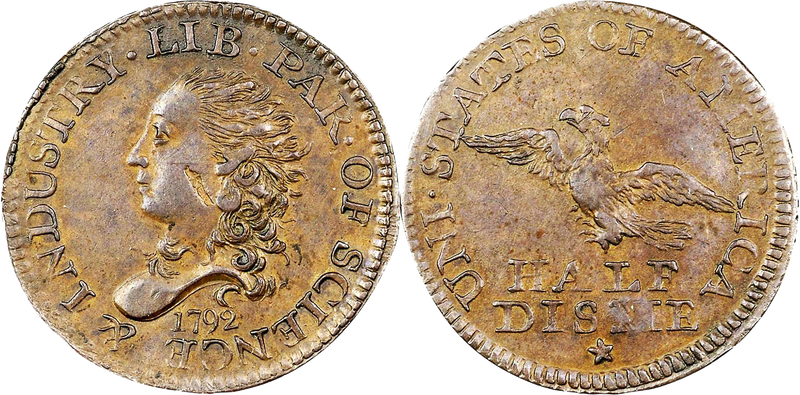
We know they mattered because George Washington said so. In his fourth annual address to Congress that November, he reported that "there has been a small beginning in the coinage of half dismes, the want of small coins in circulation calling the first attention to them."
That is the origin of the denomination — half a dime, five cents in silver, struck before the Mint had a roof. There is also a long-repeated story that Washington supplied the silver himself from his own household plate. It is a good story, and the Mint's records do not document it. The coins are real regardless.
Eighty-one years later, Congress killed the denomination outright. The half dime was not replaced by a better silver coin. It was replaced by a base-metal nickel that nobody would bother to hoard.
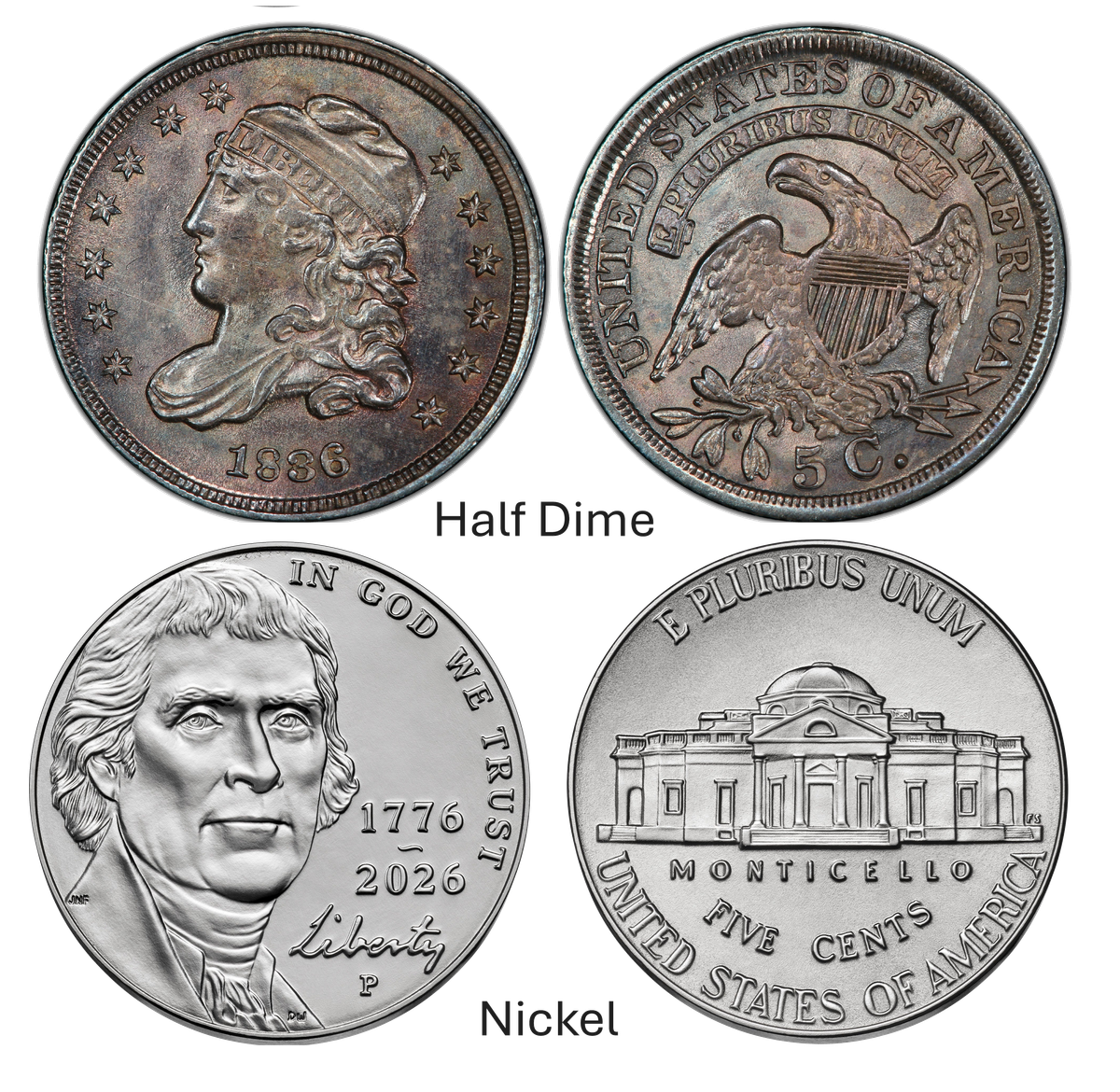
Size comparison — the tiny silver half dime next to its successor, the copper-nickel five-cent piece that replaced it.
Four Designs in Seventy-Nine Years
After the 1792 half disme, the denomination ran through four regular-issue design types.
Flowing Hair (1794–1795)
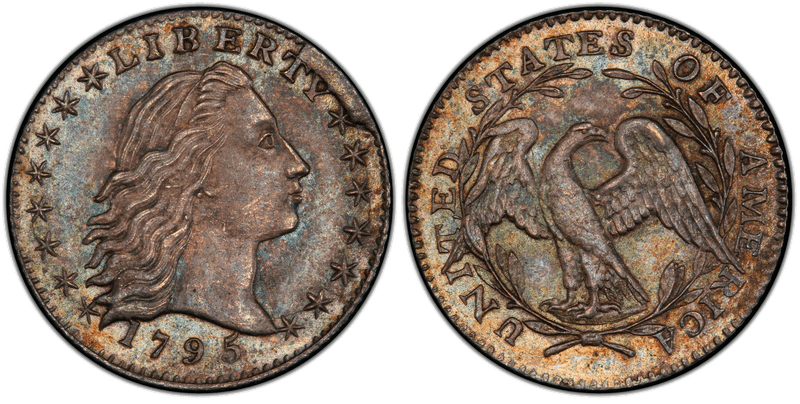
Robert Scot's design, shared with the contemporaneous half dollar and dollar — one artistic vision across three denominations, classical and deliberate. Liberty with unbound hair on the obverse, a small eagle in an open laurel wreath on the reverse. Just 86,416 struck across both years (7,756 in 1794 and 78,660 in 1795), in .8924 fine silver at 1.35 grams and 16.5mm. Scarce in every grade.
Draped Bust (1796–1805)
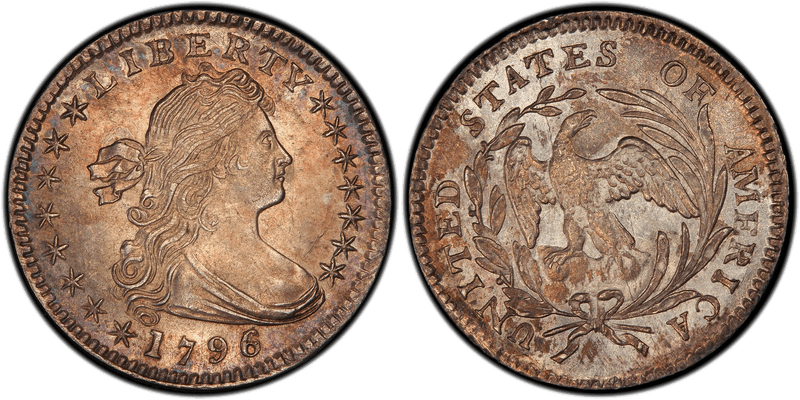
Scot again. Small Eagle reverse for 1796–1797, Heraldic Eagle from 1800. No half dimes at all in 1798 or 1799 — the Mint was busy with larger denominations and short on die-sinking capacity. The 1802 is the series rarity: a mintage of 3,060 and only about 30 known survivors, one of the lowest production figures for any regular-issue United States coin. Well-worn examples command five figures.
Then Nothing for Twenty-Four Years
No half dimes were struck between 1805 and 1829. The denomination simply stopped.
Capped Bust (1829–1837)
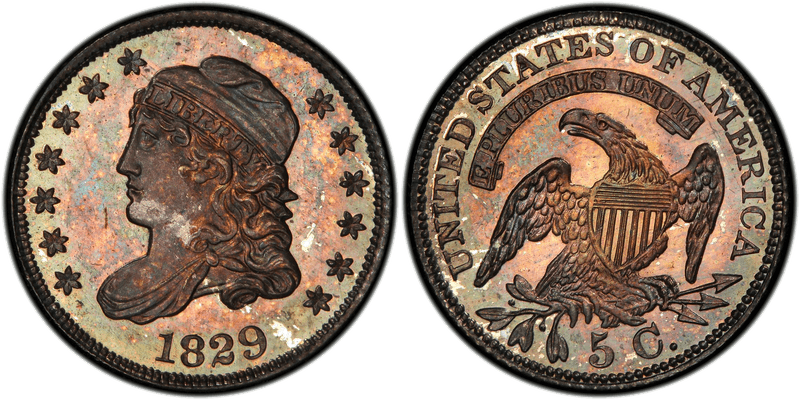
Production resumed with John Reich's Capped Bust design adapted to the denomination, struck using the close collar technology Chief Coiner Adam Eckfeldt had introduced — a real advance, producing uniform diameter and precise edge reeding instead of the variable dimensions of earlier Mint output. Nine years, healthy mintages from 871,000 to over 2.7 million, and no extreme rarities. It is one of the most completable early American silver series for a collector of moderate means.
Seated Liberty (1837–1873)
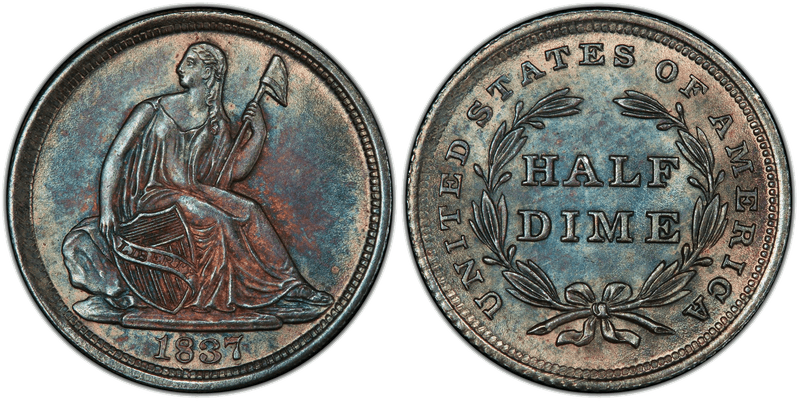
Christian Gobrecht's design carried the half dime through its final thirty-seven years, with four subtypes that each mark a specific policy decision: No Stars (1837–1838), Stars (1838–1859), Arrows (1853–1855, signaling the weight reduction), and Legend (1860–1873, replacing the stars with UNITED STATES OF AMERICA). New Orleans issues struck before the facility was seized by Confederate forces in 1861 are notably scarce.
The 1870-S is one of the great American rarities — a single example is known to exist.
Why It Died
The half dime's problem was that it was small and made of silver.
At 15.5mm and 1.35 grams it was easy to lose, and heavy circulation wore the soft silver quickly — which is why high-grade survivors across every type are genuinely elusive. But the fatal issue was the metal. Silver coins get hoarded whenever silver is worth more than the face value stamped on them, and a coin sitting in somebody's drawer is not doing the job of a coin.
The Coinage Act of 1873 ended the denomination. Its replacement had already arrived: the Shield nickel, introduced in 1866, five cents in copper-nickel — base metal, worth its face value and not much more, and therefore useless to hoard. It stayed in circulation and it is still there.
So the sequence runs: America's first federal coin was a five-cent silver piece, and it was retired in favor of a five-cent base-metal piece that nobody wanted badly enough to keep.
Why Half Dimes Are Worth a Look
This is the denomination that connects two others. The nickel exists because the half dime failed. The dime is its surviving sibling — the same silver standard, twice the size, and just large enough to stay useful.
For collectors, the half dime offers early Mint history at a fraction of what the equivalent large-denomination coins cost. A Capped Bust half dime is a genuinely attainable piece of 1830s Mint technology. A Flowing Hair is a first-decade federal coin.
Browse all 218 half dime listings in the NumisDex catalog.
Discussion
- Do you collect half dimes, or do you have a type set example?
- Seated Liberty half dimes with and without arrows — which do you prefer?
- If the Mint still made silver five-cent coins, would you collect them?
Related Reading
- The Four Designs of the U.S. Five-Cent Piece — what replaced the half dime, and why the base-metal version survived
Explore in the NumisDex Catalog
Related varieties and errors from the NumisDex database: