
The Half Cent: America's Smallest Denomination
America's Smallest Denomination: The Half Cent That Most Collectors Don't Know Exists
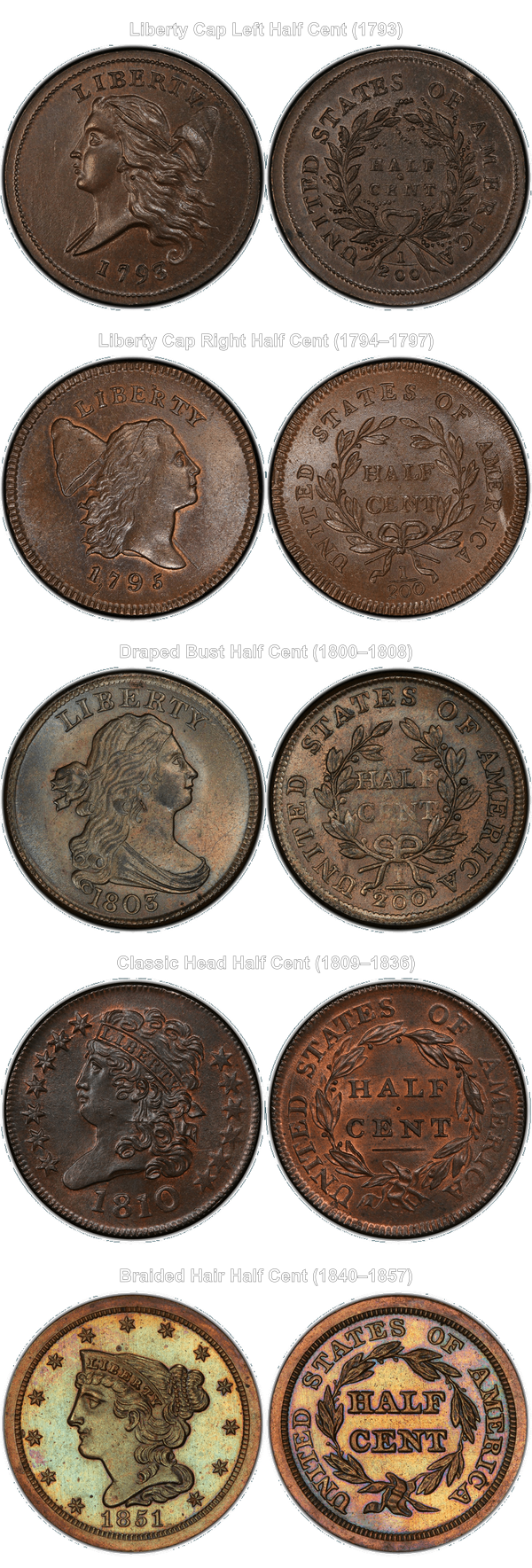
The complete half cent design evolution — Liberty Cap Left (1793), Liberty Cap Right (1794-1797), Draped Bust (1800-1808), Classic Head (1809-1836), and Braided Hair (1840-1857)
Ask most people what the smallest U.S. coin denomination is and they'll say the penny. They'd be wrong. From 1793 to 1857, the United States Mint struck half cents -- coins worth exactly half of one cent. They were among the very first coins the Mint ever produced, and their 64-year history spans five distinct designs, multiple production gaps, and some of the rarest coins in American numismatics.
The First Half Cents (1793)
The half cent was authorized by the Mint Act of 1792 and struck for the first time in 1793 -- the same year as the first large cents. The original design, the Liberty Cap Left, featured Liberty facing left with a Phrygian cap on a pole. Designed by Adam Eckfeldt and engraved by Joseph Wright, only about 35,000 were produced before the design was replaced. These are among the rarest and most sought-after early American coins.
Five Designs Across 64 Years
| Design | Years | Designer | Key Fact |
|---|---|---|---|
| Liberty Cap Left | 1793 | Eckfeldt / Wright | Only ~35,000 struck. The rarest design. |
| Liberty Cap Right | 1794-1797 | Robert Scot | The 1796 With Pole and Without Pole varieties are particularly scarce. |
| Draped Bust | 1800-1808 | Robert Scot | Production gaps in 1801-02 and 1804. The 1802 is a recognized key date. |
| Classic Head | 1809-1836 | John Reich | No coins struck 1812-1813 or 1816-1824. Later dates (1831-1836) are proof-only. |
| Braided Hair | 1840-1857 | Christian Gobrecht | 1840-1848 struck only as proofs. Business strikes returned 1849-1857, the final year. |
Why Did They Disappear?
By the 1850s, the half cent had become impractical. Inflation had eroded its purchasing power, and the small copper coins were expensive to produce relative to their face value. The Mint Act of 1857 discontinued both the half cent and the large cent, replacing them with the smaller Flying Eagle cent. The half cent simply wasn't worth making anymore.
Why Collectors Should Pay Attention
Half cents occupy a fascinating niche. They're old enough to feel historic (the oldest predate George Washington's death), rare enough to be interesting (total mintages were tiny by modern standards), and overlooked enough that prices haven't been driven up the way large cents have. Early copper specialists prize the die varieties cataloged under the Cohen (C-) attribution system, and the proof-only issues from the 1840s are among the most elegant coins the early Mint produced.
If you've never held a half cent, it's worth seeking one out. You're holding a piece of a denomination that most Americans have completely forgotten existed.
Browse half cent listings on NumisDex: