
Gold Coins: Six Denominations, One Executive Order, and the Most Beautiful Coin Ever Made
138 Years of Gold
The United States struck gold coins for 138 years — from 1795 to 1933. Six denominations, from the tiny $1 gold dollar to the massive $20 double eagle. And then one morning in 1933, a president signed an executive order, and private gold ownership became illegal.
For the first century of American coinage, gold coins were real money — the backbone of international trade and the foundation of domestic commerce. Understanding gold coins means understanding how American money evolved from hand-struck precious metal to the fiat currency we use today. The story involves a sculptor hired by a president who hated his own country's coins, a gold rush that created a new denomination, and an executive order that ended an era.
The Six Denominations
Gold Dollar ($1) — 1849–1889
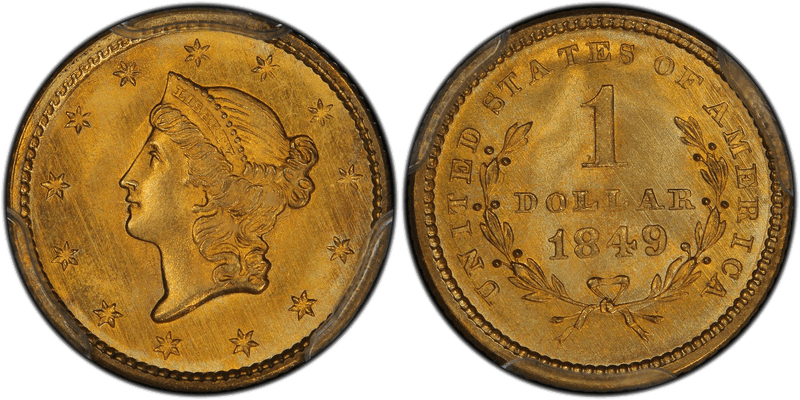
The smallest regular-issue US coin ever struck — just 13mm in diameter, barely larger than a pencil eraser. The gold dollar was created in 1849 after the California Gold Rush flooded the country with gold, and Congress needed a small gold coin for everyday commerce.
Three design types across 40 years:
- Type 1: Liberty Head (1849–1854) — The tiny original. James B. Longacre's design. So small that it was difficult to handle and easy to lose. The 1849 Open Wreath shown above is from the first year of production.
- Type 2: Indian Princess, Small Head (1854–1856) — Longacre enlarged the coin slightly and created a new design with a feathered headdress. Made for just three years — one of the shortest-lived designs in US coinage.
- Type 3: Indian Princess, Large Head (1856–1889) — The final and longest-running gold dollar design. A larger portrait that was easier to strike and handle.
The gold dollar was never popular. It was too small for practical commerce, too easily lost, and too close in size to other small coins. Congress finally discontinued it in 1889. Today, every gold dollar is collectible — the denomination's short life and small mintages make even common dates desirable.
Quarter Eagle ($2.50) — 1796–1929
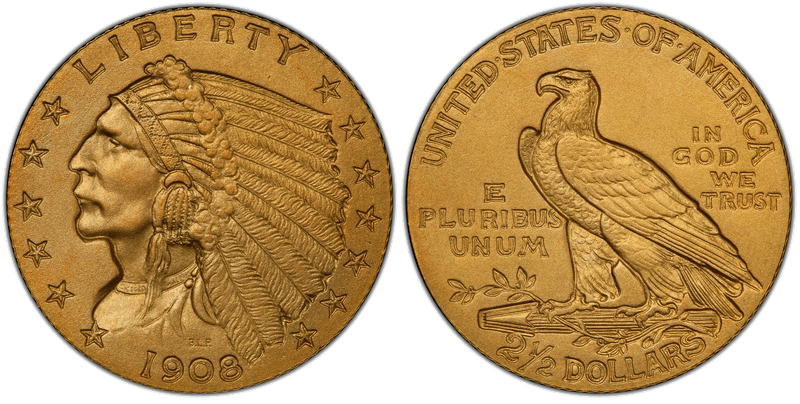
One of the longest-running gold denominations, spanning from the earliest days of the Mint through the 20th century. The first quarter eagles (1796) were struck without obverse stars — one of only a handful of US coin designs with no stars on the front.
The quarter eagle's most remarkable chapter came at the end. Bela Lyon Pratt's Indian Head design (1908–1929) is one of the most unusual coins in American numismatics: the design is incuse — sunken into the surface rather than raised. The only regular-issue US coins ever struck this way (the Indian Head half eagle shares the same concept). Critics at the time called them unsanitary, claiming the recessed areas would harbor germs and dirt. Collectors today consider them among the most distinctive and beautiful coins ever produced.
The incuse design was part of President Theodore Roosevelt's campaign to beautify American coinage. Pratt's design was controversial from the start — the American Numismatic Association officially opposed it — but Roosevelt pushed it through over objections from both collectors and Mint officials.
Three Dollar Gold ($3) — 1854–1889
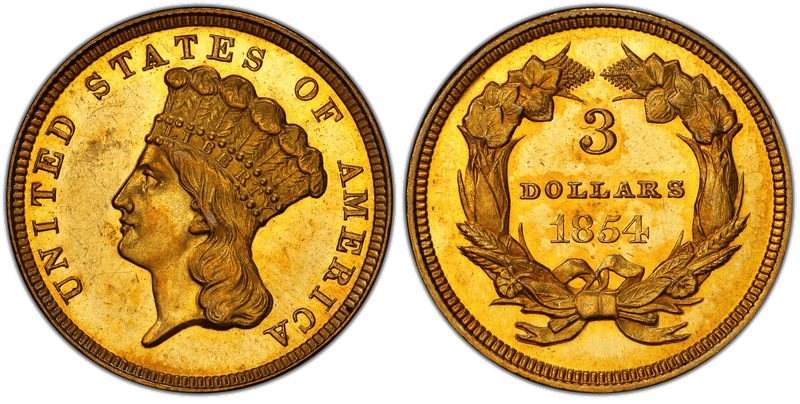
The odd denomination. Congress created the three-dollar gold piece in 1854 so that people could buy a sheet of one hundred three-cent stamps in a single transaction — paying with one coin instead of counting out individual pieces. James Barton Longacre's Indian Princess design features a distinctive feathered headdress that influenced his later designs for the Indian Head cent and gold dollar.
The denomination never caught on. Mintages were consistently low across the entire 35-year run, and the coins saw limited circulation. The three-dollar gold piece remains one of the most obscure and collectible US coin series — a denomination that existed more in theory than in practice. The key date is the 1870-S, with a mintage so low that the exact number produced remains disputed.
Half Eagle ($5) — 1795–1929
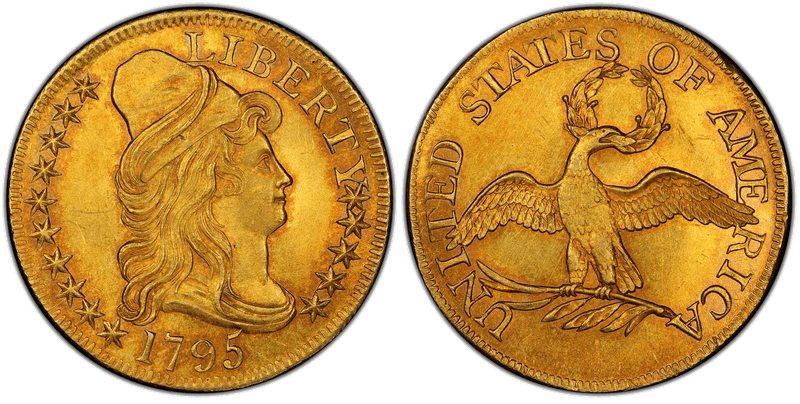
The first gold coin struck by the United States Mint. When the Philadelphia Mint began operations in the 1790s, the $5 half eagle was among its earliest products — predating the gold eagle by a few months. Robert Scot's original Capped Bust design with a small eagle reverse established the template for US gold coinage.
Five major design types across 134 years:
- Capped Bust, Small Eagle (1795–1798) — The original. Robert Scot's design. Every example is rare.
- Capped Bust, Heraldic Eagle (1795–1807) — A larger, more imposing eagle reverse.
- Capped Head (1807–1834) — John Reich's redesign. Includes the era when the Mint stopped putting denomination or value markings on gold coins (1807–1834), leading to the famous "No Motto" varieties.
- Classic Head (1834–1838) — William Kneass's design, created after Congress reduced the gold content of US coins in 1834 to prevent them from being exported for their bullion value.
- Liberty Head / Coronet (1839–1908) — Christian Gobrecht's design. The longest-running half eagle type at 70 years. Includes Civil War issues, Carson City Mint coins, and some of the most collected dates in all of US gold coinage.
The half eagle ended with the same incuse Indian Head design used on the quarter eagle — Bela Lyon Pratt's controversial sunken-relief design that ran from 1908 to 1929.
Eagle ($10) — 1795–1933
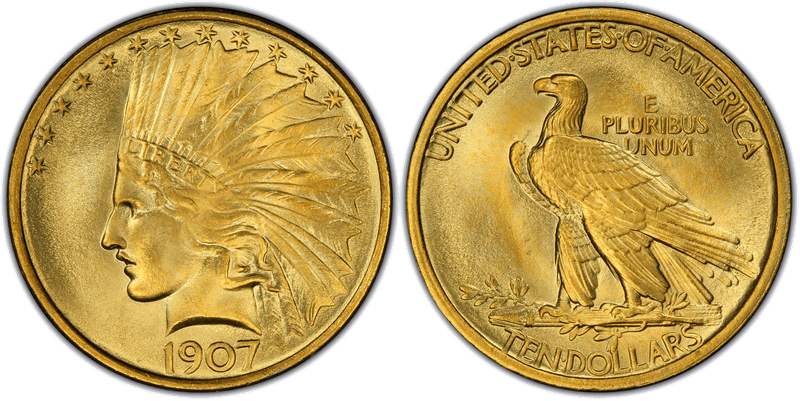
The denomination that defined the naming standard for all US gold coins. "Eagle" meant ten dollars. Every other gold denomination was named in relation to it: half eagle ($5), quarter eagle ($2.50), double eagle ($20). The eagle was the anchor of the system.
The eagle's most celebrated chapter came in 1907, when Augustus Saint-Gaudens redesigned the coin as part of Theodore Roosevelt's campaign to beautify American coinage. Saint-Gaudens' Indian Head design — featuring Liberty wearing a Native American war bonnet — is considered one of the finest achievements in American coin design. The earliest strikes included the famous Wire Rim and Rolled Edge varieties, produced in limited quantities before the design was modified for mass production.
Saint-Gaudens died of cancer in August 1907, months before his eagle design entered full production. He never saw his coins circulate.
Double Eagle ($20) — 1849–1933
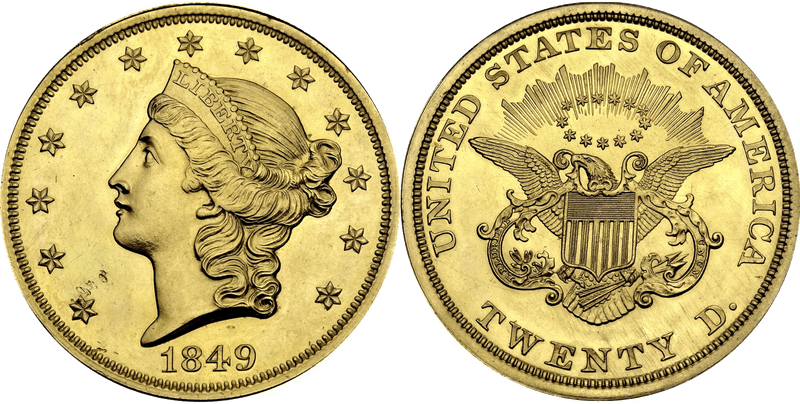
The largest regular-issue US gold coin, created in 1849 after the California Gold Rush made large gold transactions common. Before the Gold Rush, the eagle ($10) was the largest gold denomination. The flood of California gold demanded a bigger coin.
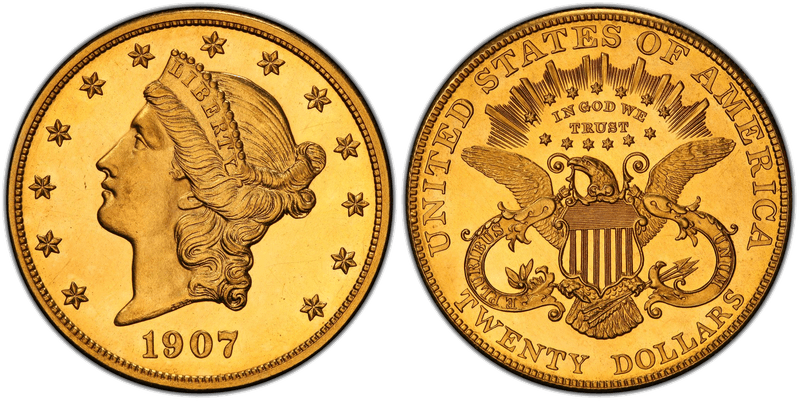
The Liberty Head double eagle (1849–1907) was James B. Longacre's design — the same engraver who created the gold dollar, the three-dollar gold piece, and the Indian Head cent. Longacre's Liberty is one of the most recognizable images in American numismatics.
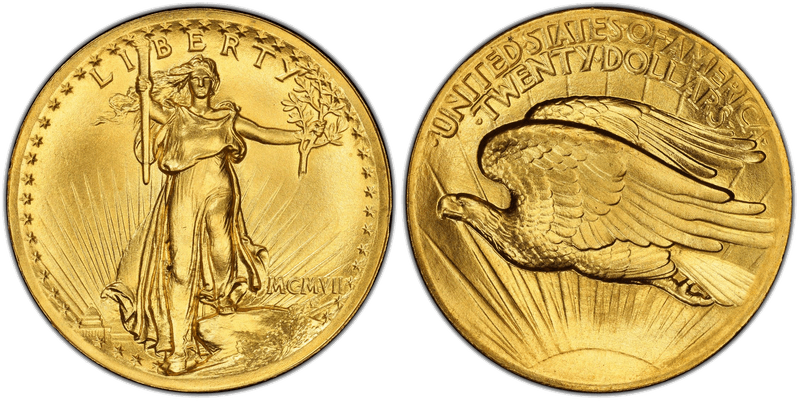
And then came the masterpiece. Augustus Saint-Gaudens' striding Liberty (1907–1933) — holding a torch and olive branch, with the Capitol building in the background and rays of sunlight streaming behind her — is widely considered the most beautiful coin ever struck by the United States. The design above is the famous High Relief variety with wire edge, produced in limited quantities in 1907 before the Mint switched to a lower relief that could be mass-produced with a single strike.
The Saint-Gaudens Story
In 1905, President Theodore Roosevelt wrote to his Secretary of the Treasury: "I think our coinage is artistically of atrocious hideousness." He wasn't wrong — American coin design had stagnated. The same basic Liberty Head motifs had been in use for decades, and Roosevelt believed the nation's coins should reflect the artistic ambition of a rising world power.
Roosevelt personally recruited Augustus Saint-Gaudens, the most celebrated sculptor in America, to redesign the $10 eagle and $20 double eagle. Saint-Gaudens had designed the famous Sherman Monument in New York and the Shaw Memorial in Boston. He was America's greatest living sculptor, and Roosevelt wanted him to bring that talent to the nation's coinage.
The collaboration was difficult. Saint-Gaudens was already battling the cancer that would kill him. The Mint's chief engraver, Charles Barber, resented the intrusion of an outside artist and resisted the new designs at every turn. Congress insisted on adding the motto "IN GOD WE TRUST" that Saint-Gaudens had deliberately omitted for aesthetic reasons — he believed the motto cluttered the design and that placing God's name on money was borderline sacrilege.
Saint-Gaudens died in August 1907. His $10 Indian Head eagle entered production that same year. His $20 double eagle — the striding Liberty that is now considered his masterpiece in miniature — followed shortly after. The original ultra-high-relief version required nine strikes per coin, making mass production impossible. The Mint produced a small number before switching to a more practical lower relief. Those original ultra-high-relief pieces are among the most valuable US coins in existence.
Executive Order 6102
On April 5, 1933, President Franklin D. Roosevelt signed Executive Order 6102, requiring all persons to deliver their gold coins, gold bullion, and gold certificates to the Federal Reserve by May 1. Failure to comply was punishable by a fine of up to $10,000 (equivalent to roughly $230,000 today) and up to ten years in prison.
The government paid $20.67 per ounce for the surrendered gold. Then, in January 1934, Congress passed the Gold Reserve Act, which revalued gold at $35 per ounce — an instant 69% devaluation of every dollar Americans held. The gold that had been purchased at $20.67 was now worth $35. The profit went to the government; the loss went to the citizens who had surrendered their coins.
Executive Order 6102 ended 138 years of American gold coinage. The coins that had been the backbone of the monetary system — from the first half eagle in 1795 to the last Saint-Gaudens double eagle in 1933 — were melted by the millions. What survived did so because collectors, banks, and foreign governments held onto their coins, sometimes in defiance of the law.
The 1933 Double Eagle
The most legally controversial coin in American history. The Philadelphia Mint struck 445,500 Saint-Gaudens double eagles dated 1933, but none were officially released into circulation before Executive Order 6102 took effect. All were ordered melted.
A handful escaped. How many and how they left the Mint has been the subject of decades of investigation, lawsuits, and legal battles. The Secret Service confiscated specimens whenever they surfaced, arguing that the coins were government property that had never been lawfully released.
In 2002, a single 1933 Double Eagle was sold at auction for $7.59 million — at the time, the most expensive coin ever sold. In 2021, that same coin sold again for $18.9 million, reclaiming the record. In 2024, ten additional specimens that had been the subject of a 20-year legal dispute between the Langbord family and the US government were resolved when the court sided with the government.
The 1933 Double Eagle is the ultimate expression of gold coinage's end in America: the most beautiful design ever struck, in the last year of production, with almost every example destroyed by the government that created it.
The Silver Transition
Gold coins told the story of American money from 1795 to 1933. The denominations ranged from the tiny 13mm gold dollar to the commanding $20 double eagle. The designs ranged from Robert Scot's primitive early portraits to Saint-Gaudens' classical masterwork. The mints ranged from a single press in Philadelphia to branch mints in Charlotte, Dahlonega, New Orleans, San Francisco, Carson City, and Denver.
All six denominations shared one characteristic: they were worth what they contained. A $20 double eagle held $20 worth of gold. A $5 half eagle held $5 worth of gold. The coin was the money, and the money was the metal. Executive Order 6102 severed that connection permanently. American coinage would never be the same.
Browse gold coin listings in the NumisDex catalog.