
The Saddle Ridge Hoard: How a Couple Walking Their Dog Found $10 Million in Gold Coins
The Greatest Buried Treasure Discovery in American History
In February 2013, a couple walking their dog on their rural property in the Sierra Nevada foothills of northern California noticed a rusty metal canister partially exposed in the ground. When the lid cracked open, gold coins spilled out. They returned with tools and eventually unearthed eight metal canisters containing 1,427 gold coins with a combined face value of $27,980 — and an estimated numismatic value of approximately $10 million.
Known by the pseudonyms "John and Mary" to protect their privacy, the couple had lived on the property for years and had walked the same path many times. The canisters had been buried just inches below the surface.
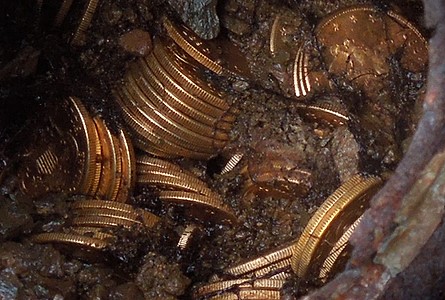
Gold coins from the Saddle Ridge Hoard — 1,427 gold pieces spanning nearly five decades.
What Was in the Hoard
The Saddle Ridge Hoard, as it became known, consisted of:
- 1,373 $20 Liberty Gold Double Eagles — the vast majority of the find
- 50 $10 Liberty Gold Eagles
- 4 $5 Liberty Gold Half Eagles
The coins dated from 1847 to 1894 — spanning nearly five decades. Many were in remarkable condition, with PCGS certifying all 1,427 coins and finding no counterfeits or alterations. Over a dozen were either the finest known or tied for finest known in the PCGS Population Report.
The combination of quantity, quality, and date range made the Saddle Ridge Hoard unique in American numismatics. It was publicly announced in February 2014 by Kagin's Inc. of Tiburon, California, the numismatic firm that handled the discovery.
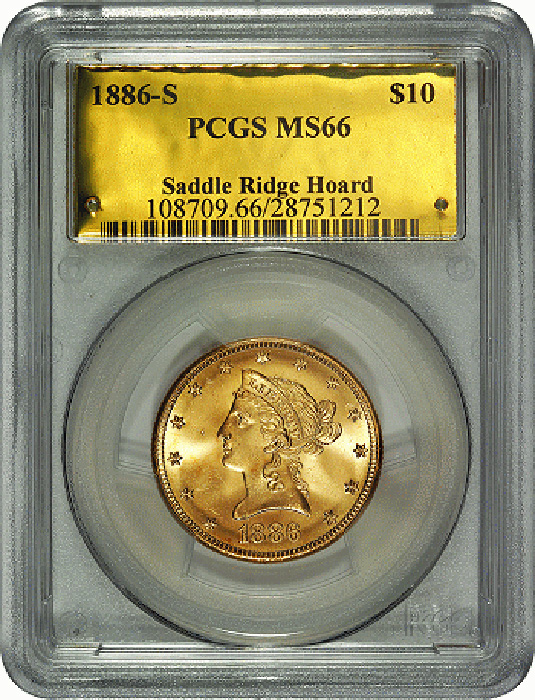
A single coin from the hoard — many pieces emerged in remarkable condition after more than a century underground.
Who Buried the Coins — and Why?
The mystery of who buried nearly $28,000 face value in gold coins (equivalent to roughly $500,000-$700,000 in purchasing power when buried) remains unsolved. Several theories have been proposed and investigated:
The San Francisco Mint Theft Theory (debunked): In 1901, an employee named Walter Dimmick stole $30,000 from the San Francisco Mint. The amount was close to the hoard's face value, leading to initial speculation. However, Kagin's and the U.S. Mint ruled this out due to the diversity of dates and denominations in the hoard — the stolen funds were in a single denomination and would not explain coins dating to 1847.
The Outlaw Theory (debunked): Links to Jesse James and the stagecoach robber Black Bart were proposed by amateur researchers but lacked supporting evidence.
The Most Accepted Theory: A previous landowner chose to store gold underground rather than in a bank. This was not uncommon in 19th-century rural California, where bank failures and distrust of financial institutions led many people to keep their savings in physical gold. The coins may have been accumulated over decades and buried in stages — explaining the 47-year date range. The owner may have died without revealing the location, leaving the hoard undiscovered for over a century.
The Broader Context: Gold Hoards in America
While the Saddle Ridge Hoard is the most valuable buried coin hoard discovered in the United States, it's not the only one. Notable predecessors include:
- The Economites Hoard (1878): $75,000 face value in gold found at a Pennsylvania commune
- The Baltimore Hoard (1934): 3,558 gold coins found in a cellar during a building renovation
- The New York Subway Hoard (1985): 14,191 coins found during subway construction
The Saddle Ridge Hoard dwarfs these in numismatic value due to the extraordinary condition of many coins and the sheer quantity of uncirculated $20 gold pieces.
What Happened to the Coins
After PCGS certification, the coins were gradually sold through Kagin's and Amazon's collectibles marketplace (since discontinued). Prices ranged from a few thousand dollars for common dates in lower grades to six figures for the finest-known specimens. The finders reportedly donated a portion of the proceeds to charity.
Lessons for Modern Collectors
- Gold survives. Coins buried for over a century emerged in remarkable condition because gold doesn't corrode. Silver and copper would not have fared as well.
- Hoards get discovered. If gold coins were hidden on properties across America in the 19th and early 20th centuries, not all have been found. Metal detecting on old properties (with permission) remains a legitimate hobby.
- Certification matters. Every coin in the hoard was authenticated by PCGS, establishing provenance and legitimacy. Without certification, buyers would have no assurance the coins weren't counterfeit.
- Legal issues are real. Treasure trove laws vary by state. In California, the Saddle Ridge finders were entitled to the hoard because it was found on their own property. Laws differ elsewhere.
Browse Liberty Gold Double Eagles in the NumisDex catalog — the same type that comprised the majority of the Saddle Ridge Hoard.