
Collar Errors: The Overlooked Third Die
Everyone Forgets About the Collar
Most collectors think of coin production as two dies — obverse and reverse. But there's a third die that's just as important: the collar. This steel ring surrounds the planchet during striking, constrains the expanding metal, forms the coin's precise diameter, and impresses the reeding on reeded-edge coins.
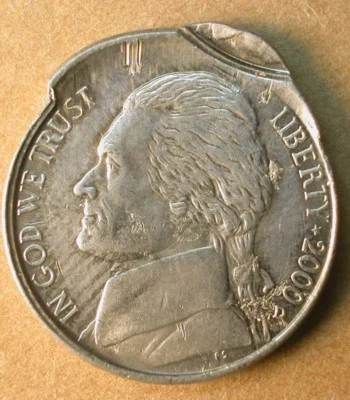
A collar break error — the distinctive "fin" of extra metal at the rim created when the collar die cracked during striking
When the collar fails, it produces some of the most distinctive errors in numismatics.
Collar Break: The Fin Effect
When the collar develops a crack from metal fatigue, planchet metal flows into the gap during striking, producing a raised fin or flange protruding from the coin's edge. The rest of the edge looks completely normal. Dramatic collar breaks create blade-like protrusions extending several millimeters beyond the normal diameter.
Unlike obverse/reverse dies that are replaced frequently, collar dies have longer service lives. A single collar may be paired with multiple die pairs, meaning a collar break worsens progressively across several die pairings. Collectors can track this deterioration.
Other Collar Errors
- Tilted collar — The collar is present but angled, producing a coin with a beveled edge (thicker on one side, thinner on the other)
- Partial collar — The planchet sits partially above the collar, leaving part of the edge smooth and part properly formed
- Collar clash — Improper contact between collar and die transfers marks
Detection Tip
Always examine the edge. Collar errors are invisible if you only look at the obverse and reverse. Rotate every coin to check its edge profile — especially when searching through rolls. A genuine collar break shows pressure-induced flow lines on the fin; post-mint filing or gouging leaves different surface textures.
Discussion
- Do you routinely check coin edges when searching, or do you focus on faces?
- Have you ever found a collar break error?
- What's the most dramatic fin you've seen on a collar break?
- Reeded vs. plain edge — which shows collar breaks more clearly?