
(1864) Copper Civil War Store Card F-320D-4a, S.S. Tuttle OH
Strike Type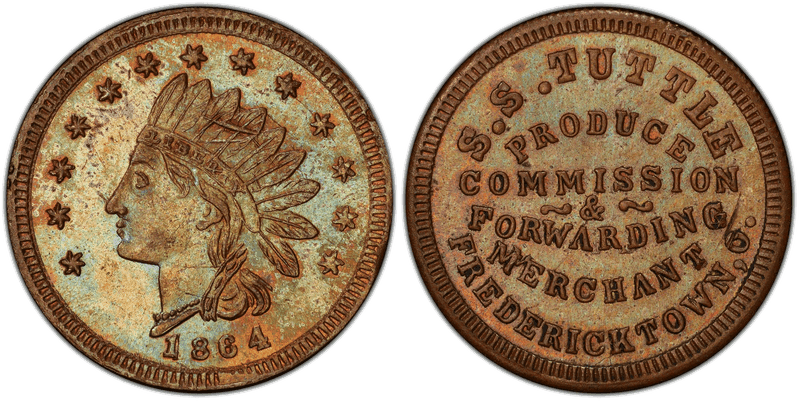
Coin Details
Description
Civil War store card issued by S.S. Tuttle of Frederick, Ohio. Ohio's extensive commercial networks across dozens of cities generated an unparalleled body of merchant token issues during the 1862-1864 coin shortage. With 3 known varieties, S.S. Tuttle produced a modest number of token types. Struck in copper, this die combination (Fuld 320D-4a) is common. Professional die sinkers like John Stanton, Benjamin True, and William Bridgens supplied dies to merchants across the Northern states. Federal coinage vanished from circulation after 1861 as citizens hoarded silver and copper for their metal value, leaving merchants to fill the void with tokens. The Act of April 22, 1864 effectively ended private coinage by imposing penalties of up to five years imprisonment and a $2,000 fine for producing unauthorized coins or tokens. Token production peaked in 1863 when the coin shortage was most acute, with die sinkers working around the clock to fill merchant orders.
Rarity Notes
Copper strikings are generally the most common metal variant for Civil War store cards, as copper was the standard planchet material mimicking the federal cent. With 3 cataloged varieties, S.S. Tuttle was a limited producer of Civil War tokens.
Cross References
Fuld 320D-4a
External References
Error Varieties
No listings found
This category doesn't have any child listings yet.