
(1864) Copper Civil War Store Card F-290E-4a, W.H. Brooks Jr. IN
Strike Type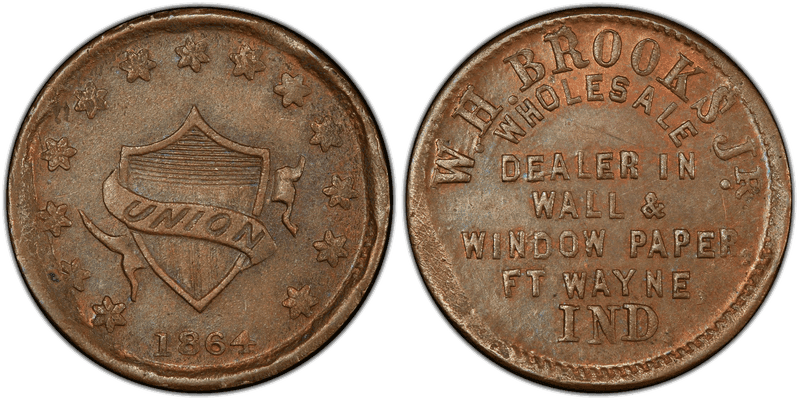
Coin Details
Description
Store card of W.H. Brooks Jr. in Ft. Wayne, Indiana, struck during the 1862-1864 token era. Indiana was an important agricultural and manufacturing state, with merchants producing store cards as emergency currency when federal coinage was hoarded. W.H. Brooks Jr. issued 8 die varieties, more than most Civil War merchants. This copper striking (Fuld 290E-4a) is common among the known varieties. Merchants typically ordered tokens from die-sinkers who maintained inventories of patriotic and advertising dies for rapid production. Store cards circulated as emergency currency after wartime hoarding removed federal coins from commercial channels. After Congress banned private coinage in 1864, the U.S. Mint dramatically increased production of small-denomination coins, and the new bronze two-cent piece helped alleviate the shortage. Civil War store cards are collected both as numismatic items and as historical documents of wartime American commerce.
Rarity Notes
Copper strikings are generally the most common metal variant for Civil War store cards, as copper was the standard planchet material mimicking the federal cent. With 8 cataloged varieties, W.H. Brooks Jr. was a minor token issuer.
Cross References
Fuld 290E-4a
External References
Error Varieties
No listings found
This category doesn't have any child listings yet.