
(1836) Token HT-141, Houck's Panacea (on 1823)
Strike Type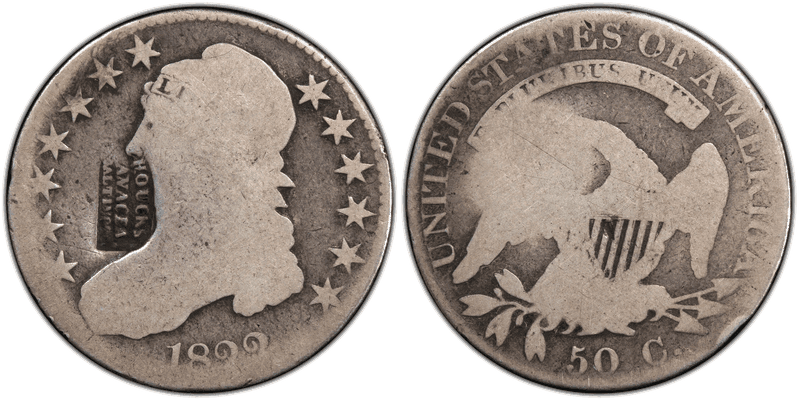
Coin Details
Description
This token bears the counterstamp "HOUCK'S PANACEA" applied to various host coins — primarily Capped Bust half dollars, but also Spanish colonial 8 reales and other silver pieces. Dr. Jacob Houck of Baltimore operated one of the most successful patent medicine businesses of the antebellum era, and his panacea (a cure-all preparation marketed for a wide range of ailments) was among the most widely advertised proprietary medicines of the 1830s. Houck's counterstamping operation converted government-issued coins into advertising vehicles by impressing his product name directly into the surfaces of circulating silver coins. This practice, while technically legal, was controversial — it defaced legal tender and was seen by some as presumptuous appropriation of government coinage for private commercial purposes. The fact that Houck chose expensive silver coins as his host medium rather than cheap copper cents reflects both the higher visibility of silver coins and Houck's desire to associate his product with quality and value. Multiple host coin varieties exist for HT-141, reflecting the diversity of silver coins available in Baltimore's commercial circulation during the 1830s. Capped Bust half dollars from various dates, Spanish colonial pieces, and other silver denominations all served as canvases for Houck's promotional counterstamp. Each host coin variety is separately cataloged, making the Houck's Panacea series one of the most complex in the Hard Times Token catalog.
Rarity Notes
Rarity varies significantly by host coin. Common hosts (1830s Capped Bust halves) are R-2 to R-3; scarce hosts (early dates, foreign pieces) are R-5 to R-7.
Cross References
Rulau HT-141; Brunk H-768
External References
Error Varieties
No listings found
This category doesn't have any child listings yet.